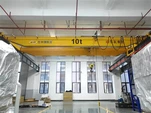
In the crane industry, choosing between a variable frequency motor and atwo-speed motor isn't just about how precise the work is-it's directly tied to parameters like the crane's lifting capacity and hoisting height. Let's break it down with real-world scenarios.
First, consider the lifting capacity. Generally, for small cranes under 5 tons-like those used in workshops to lift molds or in warehouses to move boxes-two-speed motors are common. Why? These machines handle light loads, and they typically only need two operations: slow speed (around 5 meters per minute lifting speed) for hoisting to keep things steady, and high speed (around 15 meters per minute) for moving to get the job done faster. The "two gears" of a two-speed motor fit this perfectly, and they're cost-effective-a two-speed motor system is more than half the price of a variable frequency setup, so there's no need to overspend on small equipment.
But when it comes to medium and large cranes over 10 tons, especially those 20 tons and above, variable frequency motors are usually a must. Take port container cranes (typically 30-50 tons) or construction cranes lifting steel structures (25+ tons), for example. These machines handle heavy, valuable loads, and even a small swing could cause problems. Variable frequency motors can adjust lifting speeds smoothly from 1 meter per minute to 20 meters per minute. When lifting a container, for instance, they can slow down gradually from 15 meters per minute to 2 meters per minute as they approach the target, ensuring a steady stop. A two-speed motor, switching suddenly from high to low speed with a heavy load, would likely cause dangerous swings.
Next, hoisting height matters too. For heights under 10 meters-like workshop overhead cranes, where the distance up and down is short-the slight jolt from a two-speed motor switching gears isn't a big issue, so they work fine. But for equipment like port gantry cranes (with hoisting heights over 40 meters) or mine hoists (with heights reaching hundreds of meters), variable frequency motors are essential. At great heights, the swing of a load gets amplified. A two-speed motor's "gear-jumping" speed changes could make a load swing several meters, which is far too risky. Variable frequency motors, on the other hand, offer precise control-for example, lowering a load from 40 meters high at just 0.5 meters per minute, keeping it steady the whole time.
Another key parameter is the duty class. Cranes are rated from A1 to A8, with higher classes meaning more frequent use (A6 and above, for example, work continuously for 8+ hours a day). For high-frequency operations-like cranes in steel mills lifting molten steel (A7 class)-even if the capacity isn't extremely large (say 15 tons), variable frequency motors are necessary. Two-speed motors, with their frequent gear shifts, tend to overheat and age the internal coils quickly, leading to frequent repairs. Variable frequency motors, however, have lower starting currents and less heat buildup, handling high-frequency work easily-their lifespan is often double that of two-speed motors.
In short: For small capacities (under 5 tons), low heights (under 10 meters), and infrequent use (A5 class or lower), two-speed motors offer the best value. For large capacities (over 10 tons), high heights (over 20 meters), high-frequency work, or lifting precision/heavy loads, variable frequency motors are more reliable, ensuring both safety and efficiency.