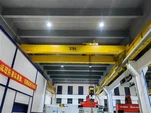
The boom: The boom is the horizontal beam that moves on the crane, rotating around a fixed point. It extends from the central mast and runs perpendicular to the ground. The reach also contains the hoist that moves and lifts the load. Depending on the crane design, the beam can move between 180 and 360 degrees.
Mast: The mast is the vertical beam where all the other components rest. It usually consists of high-strength steel and is highly durable. A mast is secured to the floor or walls of a building for use, providing support for the boom and other essential features.
Hoist: The hoist attaches to the reach and powers the lifting for the jib crane. Many types are available, depending on load types and weights. They vary by material type and power source. Hoists can consist of wire ropes, chains, or levers, and their power source can be manual, pneumatic, or electric. You can choose the type that suits your lifting requirements. For example, operators often use chain hoists for lighter loads, while wire rope hoists better suit heavy-duty weights and applications.
Trolley: Jib crane trolleys are designed to hold and facilitate the boom's weight as it moves. Trolleys remain in an immovable position while the hoists raise the load.
Festoon systems: The festoon system carries cables and power to the trolley and the boom. Festoon systems make power cables safer and easier to control. They can consist of different configurations depending on the crane type. Most commonly, festoon systems are in systems with longer booms.
Power source: Jib cranes can use electrical, pneumatic, or power lines to gain power. Some jib crane types have push-button controls to power the crane's motion. A crane operator uses the power source to control the lift without having to stand directly in the load path.